Arco della Pace
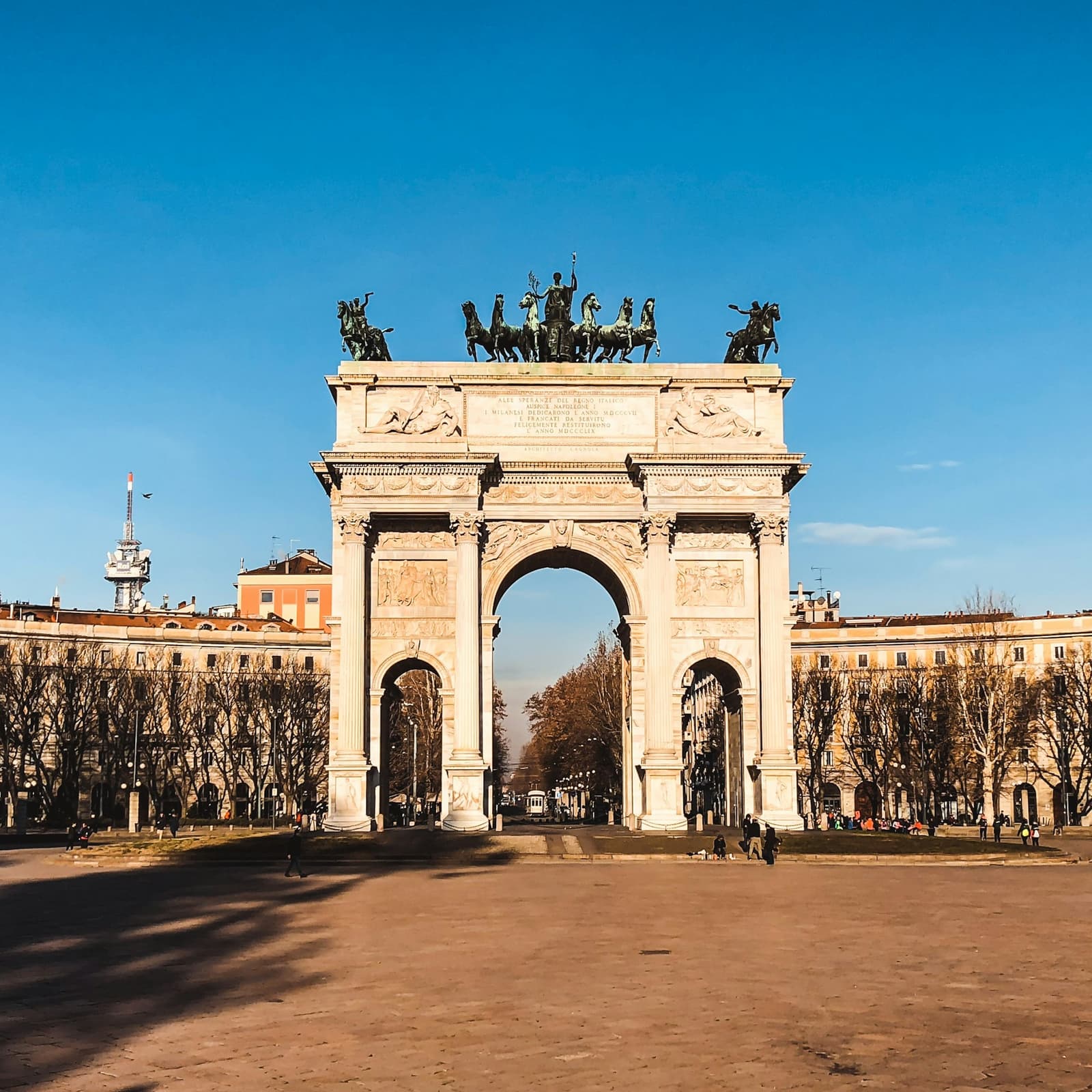
The Arco della Pace (Arch of Peace) is the marble triumphal arch on Milan’s Piazza Sempione, at the end of Parco Sempione opposite Castello Sforzesco. Designed by Luigi Cagnola for Napoleon, it was begun in 1807 and inaugurated in 1838 under the Austrians, dedicated to the peace of 1815. Free to view, it carries the Sestiga della Pace.
Updated
Key facts
- Where
- Piazza SempioneAt the north-west end of the park
- Built
- 1807–1838Designed by Luigi Cagnola
- Height
- 25 mWidth 24 m
- On top
- Sestiga della PaceBronze by Abbondio Sangiorgio
- Visit
- From outside onlyNot open inside
- Tram
- 1 and 10Arco della Pace stop
- From the castle
- 12 min on footAcross the park
Where the Arco della Pace stands
The arch stands in the middle of Piazza Sempione, just outside the park’s fence, at the opposite end from the castle.
Piazza Sempione is the round square where Corso Sempione begins, the road that leads from Milan towards the Simplon Pass. The arch stands at its centre, facing the park gate on Viale Malta, a 2-minute walk from the gate.
From the gate of the Castello Sforzesco that opens onto the park, the arch is visible at the far end of the lawns. The two are 880 m apart, a walk of 12 minutes. From the Ponte delle Sirenette, in the middle of the park, it takes 8 minutes.
- high
- 25 m
- wide
- 24 m
- archways
- 3
- Corinthian columns on each face
- 4
History: from Napoleon to the Austrians
The arch was begun to celebrate Napoleon’s victories and finished, more than thirty years later, by the power that had defeated him.
1806
The viceroy Eugène de Beauharnais wants an arch at the north-west entrance to Milan, on the road to Paris. For his arrival in the city Luigi Cagnola builds a first version in wood, and on 8 February 1806 the city council commissions him to design the permanent one.
1807
Work begins. The arch is called the Arco della Vittoria, after the French victory at Jena.
1814
Napoleon’s Kingdom of Italy falls and the works stop. Only the two smaller archways are standing.
1826
Emperor Francis I of Austria orders the arch to be completed. With the Habsburgs back, the dedication changes and the monument becomes the Arco della Pace, celebrating the European peace of 1815 agreed at the Congress of Vienna.
1833
Cagnola dies. Francesco Peverelli and Carlo Londonio take over the works.
15 September 1837
The Sestiga della Pace is raised to the top of the arch.
10 September 1838
Emperor Ferdinand I of Austria inaugurates the arch during his coronation in Milan.
1859
After the victory at Magenta, Napoleon III and Vittorio Emanuele II enter Milan through the arch. The dedications to the Austrian emperors are erased and replaced by the two inscriptions still there.
1998–2010
Two restorations cover the bronzes, between 1998 and 2003, and the stonework, between 2007 and 2010.
The arch is state property, in the care of the Soprintendenza Archeologia, Belle Arti e Paesaggio of Milan.
The statues, the reliefs and the inscriptions
The structure is clad in marble and the statues on top are bronze. Reliefs and sculptures celebrate the peace that followed Napoleon’s fall.
The Sestiga della Pace
At the top stands a bronze group by Abbondio Sangiorgio showing the goddess of Peace on a chariot drawn by six horses. She holds an olive branch in her right hand and, in her left, a staff topped by a small statue of Minerva. The statue is more than 4 metres high. It was commissioned in 1825 and cast by the brothers Luigi and Antonio Manfredini.
The Victories on horseback
At the four corners of the attic stand four Victories on horseback, by Giovanni Putti. Each offers a crown and holds a palm.
The rivers
Above the entablature sit the main rivers of Lombardy-Venetia. The Po and the Ticino, by Benedetto Cacciatori, face the castle. The Adige and the Tagliamento, by Pompeo Marchesi, face Corso Sempione.
The reliefs
The 12 reliefs on the faces show events of the Restoration, among them the Austrians entering Milan, the Congress of Vienna and the founding of the Kingdom of Lombardy-Venetia. On the sides two more show the battles of the Aube and of Leipzig. Gaetano Monti and Luigi Acquisti were among the sculptors.
The inscriptions
The two inscriptions on the attic date from 1859. The inscription facing those entering the city reads: “Entrando coll’armi gloriose Napoleone III e Vittorio Emanuele II liberatori, Milano esultante cancellò da questi marmi le impronte servili e vi scrisse l’indipendenza d’Italia” (as Napoleon III and Vittorio Emanuele II entered with glorious arms as liberators, a jubilant Milan erased the marks of servitude from these marbles and wrote on them the independence of Italy). The one on the other side records that the Milanese dedicated the arch in 1807 to the hopes of the Italic Kingdom, under the auspices of Napoleon I, and that in 1859, now free, they restored it to that dedication.
The toll houses and Porta Sempione
The two buildings either side of the arch are the toll houses (caselli daziari). Together with the arch they form Porta Sempione, one of Milan’s city gates.
Cagnola designed them too, and they were finished in the same years as the arch, between 1837 and 1838. They were used to collect the duty on goods entering the city and marked the line between Milan and the countryside.
That is why the arch was a city gate before becoming a monument. Since 1979 the arch and the toll houses have been protected together.
How to get to the Arco della Pace
The arch is served by tram. No metro station is less than ten minutes away on foot.
By tram
Trams 1 and 10 stop on Corso Sempione at the Arco della Pace stop, a few steps from the square.
By metro
The nearest stations on foot are Lanza (M2), 14 minutes away, and Cadorna (M1 and M2), 16 minutes away. Both walks cross the park.
From the castle
From the castle’s gate onto the park, walk straight along the lawns for 12 minutes.
From the Duomo
It is 2.3 km, 31 minutes on foot, through the castle and the park.
By car
The arch is inside Area C, the restricted traffic zone of central Milan, where drivers pay a charge to enter. Drivers should check the rules for Area C and parking around the park.
The Olympic cauldron of 2026
During the Milano Cortina Winter Games, Milan’s Olympic cauldron was at the Arco della Pace. Nothing of it remains at the arch today.
The cauldron hung under the central archway. A second cauldron burned in Cortina d’Ampezzo, on Piazza Dibona. According to the organisers, it was the first time two cauldrons were lit and extinguished at the same time in two locations.
It was lit on 6 February during the opening ceremony and put out on 22 February 2026. It burned again for the Paralympics, from 6 March to 15 March 2026. In those weeks a show of 3 to 5 minutes, with music by Roberto Cacciapaglia, was repeated every hour through the evening, until 23:00.
It was designed by Marco Balich, Lida Castelli and Paolo Fantin, who took Leonardo da Vinci’s Knots as their model for an aluminium structure that opened and closed from 3.1 to 4.5 metres across. After the Games it was dismantled. In September 2026 it was in a warehouse in Milan, with no new home.
Events and evenings around the arch
Piazza Sempione is where parades and races finish. In the evening it is an area of bars.
In late June the Milano Pride parade ends at the arch, with the closing event on a stage in the square. In 2026 the 10 km and 5 km runs of the Stramilano, the city’s spring race, finished here.
In the evening the outdoor tables fill up on the square and at the start of Corso Sempione, behind the arch, where bars and restaurants stand side by side. This is where people come for an aperitivo at the Arco della Pace.
Frequently asked questions
What is written on the Arco della Pace?
The attic carries two Italian inscriptions from 1859, one on each side. They record the entry into Milan of Napoleon III and Vittorio Emanuele II after the victory at Magenta, and the independence of Italy. They replaced the dedications to the Austrian emperors Francis I and Ferdinand I, erased that same year.
Who is on top of the Arco della Pace?
At the top of the arch stands the goddess of Peace, on a chariot drawn by six horses. This is the Sestiga della Pace, a bronze group by Abbondio Sangiorgio raised in 1837. The statue of the goddess is more than 4 metres high. At the corners of the attic she is joined by four Victories on horseback, the work of Giovanni Putti.
Can you go up the Arco della Pace?
It is not possible to climb the Arco della Pace, as no visits inside or to the top are available, and the arch can be viewed from the square at any hour. A metal platform on the top was removed in the restoration finished in 2010, to clear the view of the statues. In the past the Soprintendenza has run guided visits at the foot of the arch.
How far is the Arco della Pace from the Duomo?
The Arco della Pace is about 2.3 km from the Duomo, or 31 minutes on foot. From the Duomo to the entrance of Castello Sforzesco it is 16 minutes, then 3 more across the courtyards and 12 from the gate onto the park to the arch. When the park or the courtyards are closed, you have to walk round the fence.
Why is it called the Arco della Pace?
It takes its name from the European peace of 1815, reached at the Congress of Vienna, to which the Austrians dedicated it after Napoleon’s fall. It had been begun in 1807 as the Arco della Vittoria, to celebrate French victories. Emperor Francis I ordered its completion in 1826, and the name changed with the new dedication.